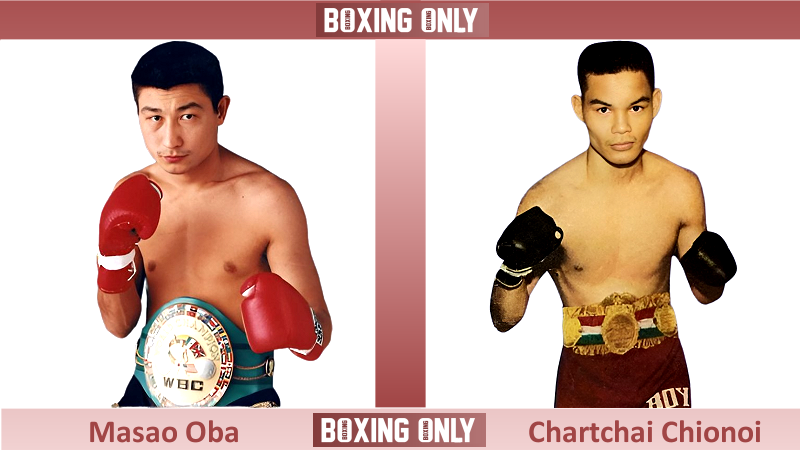
On January 2, 1973, the Nihon University Auditorium in Tokyo hosted a compelling flyweight world title clash between Japan's reigning WBA Flyweight Champion, Masao Oba, and Thailand's former WBC Flyweight Champion, Chartchai Chionoi. Both men carried significant reputations into the ring, and their clash promised a collision of styles and narratives: Oba, the sharp, technically disciplined champion with a relentless gas tank, and Chionoi, the gritty, battle-tested former champion who had already weathered some of the most gruelling fights in flyweight history.
Oba, who entered the bout with a record of 34 wins, two losses, and one draw, had been the WBA titleholder since defeating Berkrerk Chartvanchai in October 1970. He had made five successful defences, including victories over Betulio Gonzalez and Fernando Cabanela, showcasing his ability to outbox and outlast challengers at the championship level. His opponent, Chionoi, brought an extensive resume into the fight, with 57 wins and 14 losses. He had previously held the WBC Flyweight Title twice, having defeated Walter McGowan and Efren Torres, only to lose the belt to Erbito Salavarria in a short-lived second reign.
From the opening bell, Chionoi wasted no time imposing his presence. The first round was a disaster for Oba, who was caught cold by a thunderous right hand from the Thai challenger. The punch sent Oba stumbling backwards and onto the canvas. The crowd gasped as their champion struggled to his feet, visibly shaken and with referee Yusaku Yoshida administering the mandatory count. For the remainder of the round, Chionoi piled on the pressure, forcing Oba onto the ropes and threatening to end the fight early. Oba, however, showed remarkable composure under fire, using clinches and subtle head movement to survive the round.
In the following rounds, Oba began to find his rhythm. Utilizing his superior jab and lateral movement, he worked to keep Chionoi at range while delivering sharp counters whenever the challenger lunged forward. Chionoi, despite his aggression, started to show signs of fatigue by the middle rounds as Oba's cleaner work and efficient shot selection began to take effect.
By the eighth round, the momentum had entirely shifted. Oba was now dictating the pace, peppering Chionoi with precise combinations and using his footwork to avoid the Thai fighter's increasingly desperate attacks. The champion's confidence grew with each passing round while Chionoi's energy reserves dwindled. The former champion, still dangerous with his looping hooks and wild overhands, couldn't break through Oba's disciplined defence.
As the fight entered the championship rounds, Oba increased his tempo. In the eleventh round, the Japanese champion landed a sustained barrage of punches that had Chionoi reeling. Oba's combinations flowed with mechanical efficiency, targeting the head and body. Chionoi, bloodied and exhausted, still refused to fold, displaying the tenacity that had defined his career.
In the twelfth round, Oba closed the show. With the crowd on its feet, the champion unleashed a relentless sequence of punches—hooks, uppercuts, and overhand rights—that overwhelmed Chionoi entirely. Backed into a corner and unable to mount any meaningful resistance, Chionoi was caught by a final, crushing combination that sent him crumpling to the canvas. Referee Yusaku Yoshida began the count, but it was clear the fight was over. At precisely the three-minute mark of the twelfth round, Chionoi was counted out, and Masao Oba had secured one of the most dramatic victories of his career.
The scorecards leading up to the stoppage reflected Oba's dominance in the latter stages of the bout. Referee Yusaku Yoshida had it 53-48, Judge Takeo Ugo scored it 53-49, and Judge Shoichi Kato tallied it 52-50, all in favor of Oba.
This victory marked Oba's sixth successful title defence and cemented his status as one of Japan's finest flyweights. Tragically, this would also be his final fight. Just weeks after this career-defining performance, Masao Oba died in a car accident, cutting short what was shaping up to be a legendary career in Japanese boxing history.
For Chionoi, the loss marked the end of his pursuit of another world title. Despite his decline, his legacy as a two-time world champion and one of Thailand's greatest fighters remained firmly intact.
The Oba-Chionoi encounter is a vivid example of championship grit, resilience, and the fleeting nature of boxing careers. It remains a haunting reminder of Masao Oba's brilliance, whose talent was taken far too soon, and a testament to Chartchai Chionoi's warrior spirit, who fought valiantly even in defeat.

Comments (0)
Please log in to leave a comment
Loading comments...